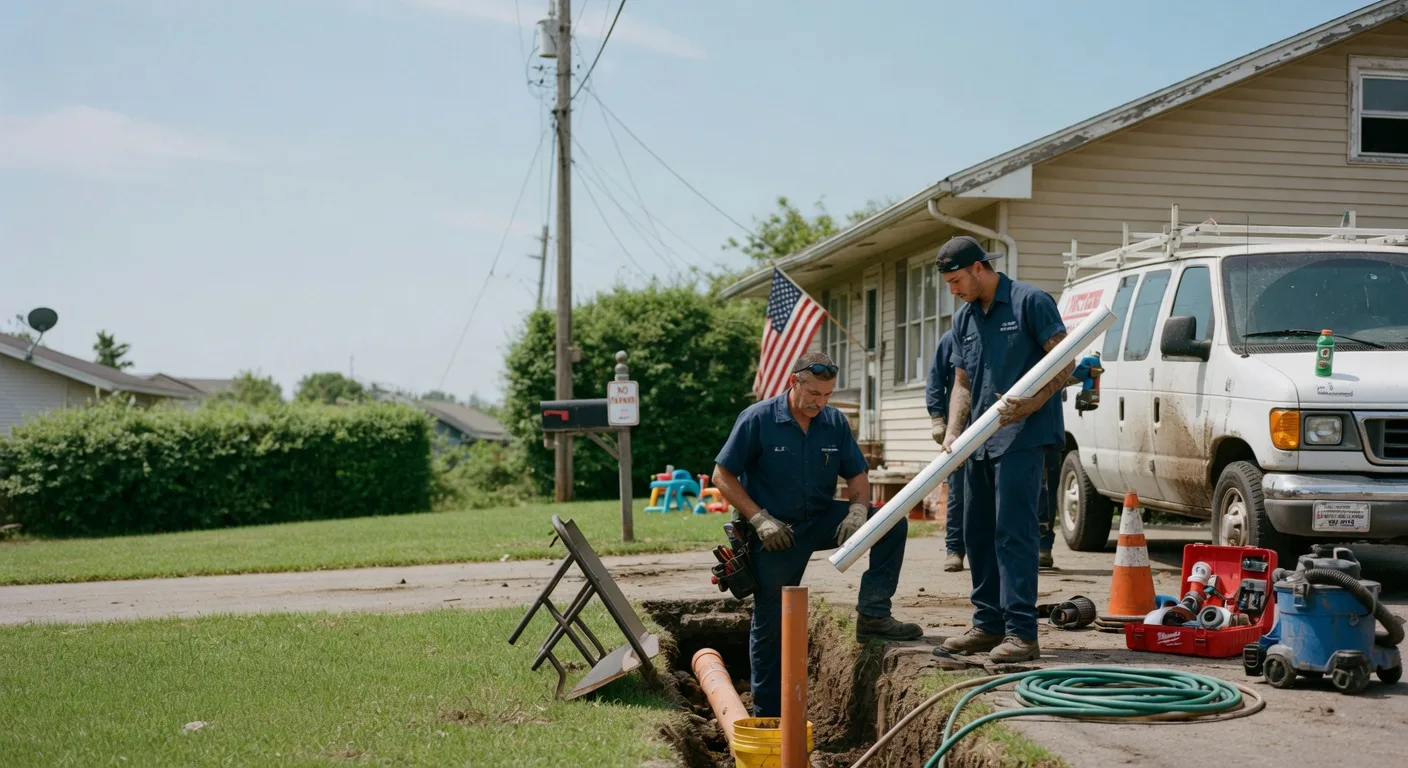
How do I know if tree roots have gotten into my sewer line?
Tree roots get into a sewer line through a hairline crack or a loose joint. Clay pipe is the usual victim because it is laid in short sections, so there is a joint every few feet for a root tip to find. Roots follow moisture, so a strand enters, thickens, and starts catching paper and grease until flow stops. Warning signs are a main line that clogs on a predictable schedule, gurgling from drains near large trees, and a cable machine that keeps stopping at the same distance. One slow fixture is rarely roots. Several drains slowing together, or a basement floor drain that rises, points to the main line where roots live. A cable with a cutting head opens a channel through the mass for temporary relief, and hydro jetting scours the pipe wall more completely, but neither seals the entry point, so the roots return. A camera inspection shows the crack or joint, how much root is present, and the pipe's condition, which decides whether periodic cutting is enough or a section needs repair. Access and the length of pipe involved drive that cost. PVC resists root entry far better than clay. For a suspected root problem in Barnwell, SC, Expert Plumbers Co connects you with an independent local plumber.
Prevention around trees is worth knowing about, because the root itself is rarely the whole story. Not every tree is a threat, and removing one is rarely the right first step, since the roots already in the pipe do not stop growing and the pipe's joints stay open. Willows, maples, poplars, and similar fast growers tend to be the worst for seeking out sewer lines, but any large tree in a dry spell can send roots to a pipe that holds moisture. Avoid pouring rock salt or copper sulfate products into toilets without asking a plumber first, since they can harm pipe and the wider water system. Keep records of when the line was last cut or jetted. If the intervals between clogs are getting shorter, that is a sign the root mass is thickening and a repair may soon be better value than repeated cleaning. Ask the plumber about replacement options.
We just built or remodeled and the drains are already slow. Why?
The plumbing is new, and the tub drains like an old one. Or the sink gurgles whenever the washer runs. New work should not do this, and the cause is usually in how the pipe was set.
Four causes come up. First, not enough fall on a horizontal run. Water needs slope to carry solids, and a flat run leaves them behind. Second, a vent that was never tied in or was capped. The line cannot breathe, so you get gurgling and slow flow with no clog. Third, construction debris left in the line: grout, drywall mud, thinset, sand. It sets hard on the pipe wall. Fourth, a trap arm run too long.
One slow fixture points to its own trap arm, slope or vent. Several fixtures slow together, or the lowest drain backing up, points to the main run, a debris plug or a vent problem.
Safe homeowner check: note which fixtures are slow and listen for gurgling. Do not climb onto the roof. Stop running water and call now if water or sewage comes up in a tub or floor drain.
A camera inspection is the right first step on new work. It shows a flat section, a ridge of hardened material on the pipe wall, or a vent that never connected. Repeat cabling just pokes a hole through the problem, and it returns. A cable machine is enough for a soft, loose blockage. Hardened cementitious debris often needs hydro jetting. Slope and vent faults need the piping corrected, and what that involves follows access, materials, how much has to be opened up, and any permit or inspection.
Expert Plumbers Co is a referral service. We refer homeowners in Barnwell, SC to an independent local plumber for Drain Cleaning and Emergency Drain Cleaning. Call (380) 262-9173.
Keep a record while the work is fresh. Photograph any open walls or trenches before they are closed, and write down the date the slow drains first showed up. If a builder or remodeling contractor did the work, the fault may be theirs to answer for. A written note from the plumber describing what the camera found, such as a flat section or hardened debris, helps far more than a general complaint.
Tell the plumber when the work finished, which fixtures were added and whether the main line was touched.
A common mistake is pouring strong drain chemicals into a new line. They rarely touch hardened grout or thinset, they can damage fittings, and they make later cabling or jetting unsafe for whoever handles it. Another is waiting for the problem to settle. Construction debris does not wash away. Ask whether any air admittance valves were used in place of a full vent, and whether local code allows them.
The toilet is clogged. When is a plunger enough, when do I need a closet auger, and when is it the main line?
A plunger is enough when the bowl is slow or full but the clog is close, usually paper or a bit too much of everything. Use a flange plunger that seals over the drain opening. Push gently first to push out the air, then pump firmly for 15 to 20 strokes. If the water drops and the toilet flushes freely, that was it. Do not flush again until the bowl has drained.
A closet auger is the next step when the plunger fails twice or the toilet clogs again right away. It is a short cable with a curved head made to pass through the toilet's trap without scratching the porcelain. Feed it in, turn the handle, and pull back out whatever it catches. It reaches a clog the plunger cannot pull or push, such as a wad of wipes or a solid object.
It may be the main line when the toilet is not the only sign. Look for these:
Other drains are slow too.
The tub or shower gurgles or backs up when the toilet is flushed.
Water rises in a floor drain or low fixture.
A plunger and an auger give no lasting relief.
If you plunge and water or sewage comes up in the tub or another fixture, stop. Do not keep flushing. The blockage is past the toilet, in a branch or the main sewer line, and more water only pushes it into the house.
Stop and call if sewage is spreading on the floor, or if you hear gurgling and smell sewage. Clearing a main line may call for a cable machine, hydro jetting or a camera, depending on what is in there and how often it returns. Cost depends on access to a cleanout, how far the machine has to travel and what is found.
Avoid chemical cleaners in a standing toilet. They do not move a solid clog and they splash onto skin and eyes.
Expert Plumbers Co can connect you with an independent plumber in Barnwell, SC for this: call (380) 262-9173.
Do enzyme or bacterial drain treatments actually work?
Your drain is slow and the bottle on the shelf says it eats clogs. Does it work? A little, in the right situation, and no for most clogs people buy it for.
Enzyme and bacterial products break down organic film: grease, soap residue, food particles and the slimy layer that builds on the inside of a pipe. They work slowly, over days and repeated doses. Used that way, they help keep a clean line clean.
What they cannot do is just as important. They will not dissolve a hairball in a tub trap, a wad of wipes, a child's toy or a solid plug. They do nothing to tree roots growing into a clay joint. They cannot lift a bellied line that holds water, flatten a collapsed section, or seal a cracked pipe. Scale inside old cast iron is mineral, not organic, so it does not respond either.
If one fixture is slow, the cause is usually local: hair, soap scum or grease in that trap or branch. If every drain in the house is slow, or water backs up in the lowest fixture when you run the washer, the problem is in the main line, and a bottle from the shelf will not reach it.
Safe homeowner check: remove the stopper or strainer and clear what you can by hand. Try a plain plunger. Flush with hot tap water, not boiling, which can soften or damage some pipe and fittings. If you use an enzyme product, follow the label, usually at night when the drain sits unused. Do not mix it with chemical openers.
Stop running water and call now if sewage or gray water comes up in a tub, shower or floor drain, if the toilet and the sink back up together, if gurgling comes from several fixtures.
A cable machine is enough for a single soft clog or a simple plug in one branch. If the line keeps slowing down, a plumber may suggest hydro jetting to clean the full pipe wall, or a camera inspection to see roots, a belly or a damaged joint before anything else is done.
Expert Plumbers Co is a referral service. We connect you with an independent local plumber in Barnwell, SC. Call (380) 262-9173.
Ask the plumber what they found on the pipe wall, not just whether the water now runs. If it was grease or film, ask whether a maintenance routine makes sense for your line. If it was roots, a belly or damage, ask what repair is involved. The scope depends on access to the pipe, the materials needed, how much has to be opened up, and any permit or code requirement.
We wash the dog or muddy gear in the tub or laundry sink. Can sand and mud clog the line?
Washing the dog in the tub feels harmless. The water runs away, the bathroom smells of wet fur, and an hour later the tub drains slowly. Muddy boots, gardening gear and sports kit in the laundry sink do the same thing over time. Yes, sand and mud can clog a line.
The problem is how they travel. Water carries sand and grit along, but only while it is moving fast. In a trap, a flat run or a low spot in the pipe, the flow slows and the grit drops out. It settles, packs down and mixes with pet hair, soap and grease to form a dense sludge. Each wash adds a little more. Eventually the pipe is narrow enough that normal use overflows it at peak load.
Hair and grit also catch on any rough spot, such as scale in cast iron or a root mat at a clay joint, and a bellied line holds the settled material in place. It does not flush away on its own.
The key question is where it is happening. If only the tub or laundry sink drains slowly, the clog is likely in that fixture's trap or branch line. If the toilets gurgle and other drains back up as well, the sludge has moved into the main.
Safe homeowner check: stop washing pets or gear in the tub and laundry sink for now. Fit a fine hair catcher over the drain. Use a bucket and the yard hose for muddy boots and dog baths outside when weather allows. Do not pour chemical drain cleaners into a line with packed sand, since they do not dissolve it.
Stop running water and call now if sewage or gray water is coming up in a tub or floor drain, if the drain is overflowing, or if you smell sewage. Do not keep running the washer while the line is backed up.
A cable machine can open a path through packed sludge, but it often leaves settled sand behind, so the drain slows again. Hydro jetting flushes the sand and mud out of the line. If the trouble keeps returning, a camera inspection shows whether a belly, root intrusion or damaged joint is trapping it.
Expert Plumbers Co is a referral service. We connect you with an independent local plumber in Barnwell, SC. Call (380) 262-9173.
Tell the plumber exactly what goes down the drain, including pet washing. Ask whether the trap was cleaned and whether the main was jetted or only cabled. Scope depends on access, how far the buildup extends, whether a section has to be opened up, and any permit or code requirement for repairs. A cleanout near the fixtures makes future service simpler.